
What if one of the most consequential misunderstandings about ADHD is that we keep treating it as a problem of attention? We picture a distracted student, an unfinished to-do list, a person who cannot sit still. We think of productivity, medication, or the familiar joke that everybody has a little ADHD.
But for some people, the cost is not simply unfinished work. It is the money they spend without a plan, the relationship they neglect while absorbed in a new pursuit, the promise they cannot sustain, or the risks they take despite knowing better.
ADHD does not explain every reckless choice, and many people with ADHD are cautious rather than impulsive. Still, difficulties with inhibition, attention regulation, planning, and follow-through can shape the course of an entire life.
“The problem is not always a lack of desire. Sometimes it is the difficulty of governing desire.”
The hunger for life
Every person has an instinctual pull toward what feels rewarding: adventure, love, novelty, freedom, achievement, connection, and meaning. Freud called the pleasure-seeking part of the mind the id. His account is a psychological metaphor, not a modern map of the brain.
In my Wilder Method framework, I use Instinctual Drive—or ID—to describe the energy that moves us toward life. It is the part of us that wants to act, explore, express ourselves, take risks, and pursue what matters.
When the same drive builds and threatens a life
The same appetite for life that can build a business, inspire a courageous conversation, or fuel years of meaningful work can also become dangerous when it outruns judgment, resources, or the ability to stop. A person may be deeply committed to the people they love and still repeatedly sacrifice those relationships to the next urgent pursuit.
For years, much of my work focused on helping people who were overly inhibited: people-pleasers, conflict avoiders, self-critics, and those who could imagine a fuller life but were afraid to pursue it. I encouraged them to enter the cave—to face the thing they feared.
But my own experience has forced me to confront the other side of that message. Some people do not need more permission to pursue what excites them. They need help placing limits around pursuits that already consume their attention, money, time, and relationships.
“For some people, the cave is taking the risk. For others, the cave is learning when to stop.”
6 Instincts. 1 Essential Question.
The Wilder Method assessment explores six dimensions of instinctual expression. They are not ADHD symptoms or diagnostic scales. Instead, they provide a language for asking where a person feels free to act—and where that freedom may need better direction.
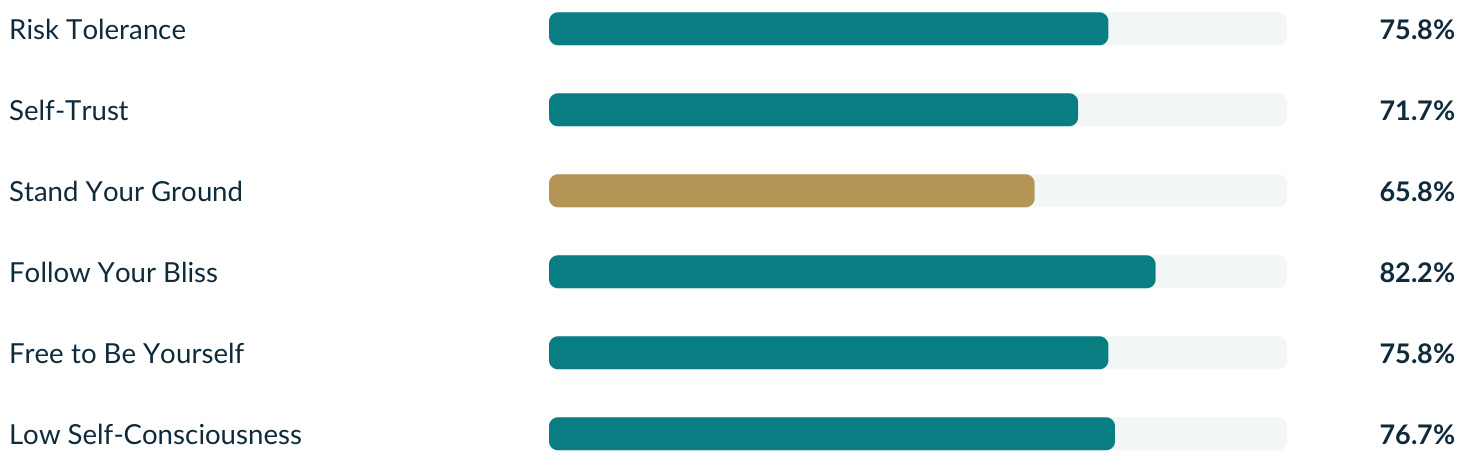
Illustrative scores from one Wilder Method assessment self-report. Percentages are proprietary descriptive scores, not clinical norms, ADHD probabilities, or objective measurements of impulse control.
01 | RISK TOLERANCE concerns the willingness to act amid uncertainty. Too little may mean missed opportunities; too much without careful evaluation may invite unnecessary danger.
02 | SELF-TRUST concerns confidence in one’s judgment. Healthy trust helps us act independently, but confidence must remain open to evidence and correction.
03 | STAND YOUR GROUND concerns boundaries and assertiveness. Sometimes the challenge is saying no to other people; sometimes it is saying no to our own impulses.
04 | FOLLOW YOUR BLISS concerns the pursuit of what feels meaningful and alive. It can sustain remarkable effort, but it can also pull attention away from obligations that do not offer immediate reward.
05 | FREE TO BE YOURSELF concerns authenticity and the freedom to live without constant performance. It asks whether we can express who we are without becoming captive to an image of who we must be.
06 | LOW SELF-CONSCIOUSNESS concerns the capacity to participate, create, and connect without excessive self-monitoring. Freedom from inhibition is valuable; it is not the same as freedom from consequences.
These dimensions raise a question that I now believe is as important as instinctual strength itself: Can you regulate that instinct in ways that protect the life you are trying to build?
A powerful drive is not the same as a regulated drive
My own exploratory self-report offers an example. Follow Your Bliss was among my highest instinctual dimensions, while a separate Six Sides questionnaire showed substantially lower self-reported consistency in everyday self-control. That contrast was not a diagnosis. It was a prompt to look at a painful gap between enthusiasm and execution.
I could think deeply about a project and become absorbed in it for hours, while routine paperwork, financial planning, and ordinary boundaries remained difficult to maintain. I could see a future clearly without building the dependable systems that future required.
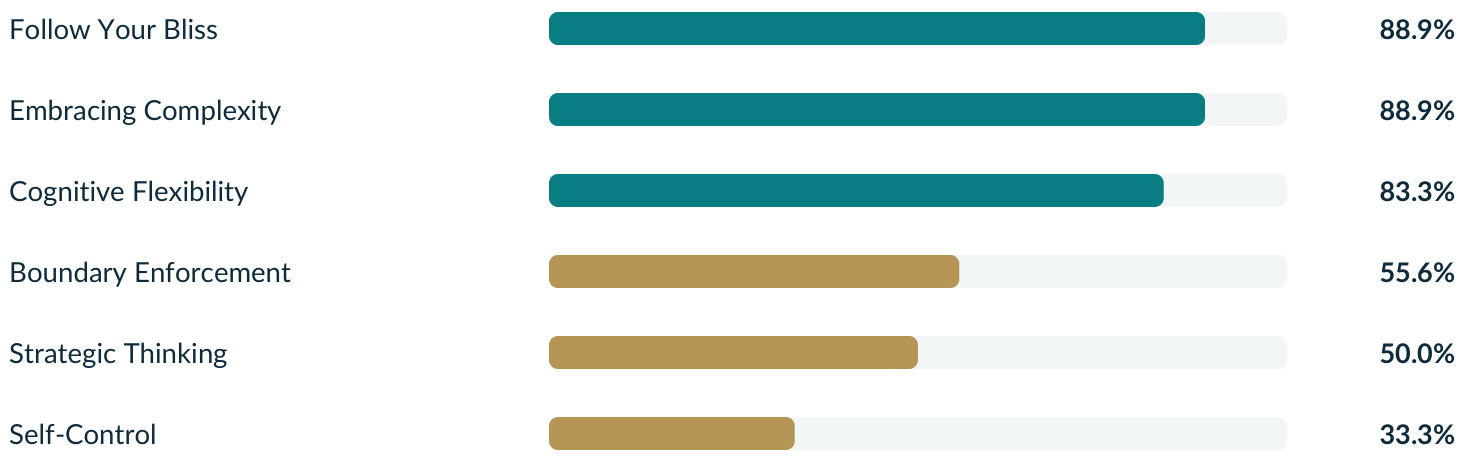
Selected scores from the same individual’s separate Six Sides questionnaire. The contrast is exploratory, not diagnostic; different scales and scoring rules should not be interpreted as a validated clinical comparison.
It is tempting to call this an overactive ID. But that is too simple. The problem may not be the strength of the desire. It may be the relationship between desire, attention, inhibition, working memory, emotional regulation, and the structures available to support behavior.
ADHD is not simply out-of-control behavior
ADHD is a neurodevelopmental condition characterized by persistent patterns of inattention and/or hyperactivity-impulsivity that interfere with functioning. Not everyone with ADHD seeks risk or novelty. Some primarily struggle to begin tasks, organize information, remember commitments, manage time, or shift attention. Others experience more pronounced impulsivity.
Reward and motivation matter, but ADHD cannot be reduced to a single dopamine story, a pleasure-seeking personality, or a weak moral compass. The ID framework offers a way to reflect on the human experience of wanting and choosing; it is not a neuroscientific explanation of ADHD.
ADHD does not necessarily change what we want out of life. It can change how difficult it is to direct our attention, manage impulses, begin or finish important tasks, and consistently act in ways that protect what matters most. A person can have strong values and sincere intentions while still needing more support to put them into practice.
“ADHD can be as much about difficulty stopping as difficulty starting.”
That sentence does not describe every person with ADHD. But it captures a reality that often gets lost when we talk only about productivity: a person may struggle to disengage from what is compelling even when other priorities urgently need attention.
When the pursuit begins to threaten what matters
The consequences of poorly regulated behavior can be much larger than missed deadlines. Impulsive spending can weaken financial security. A succession of exciting projects can crowd out the unglamorous work that protects a career. Constant absorption in work can make a partner feel alone. Unchecked risk-taking can threaten professional standing, health, or hard-earned trust.
These outcomes are not inevitable features of ADHD. They also have many possible causes. But for someone whose attention, inhibition, or planning is impaired, the stakes can be much higher than a messy desk. That is why ADHD deserves a serious assessment rather than a joke about being distracted.
“A person can spend years building a life and still struggle to stop the behaviors that put it at risk.”
The Wrangler: why understanding is not enough
I have begun thinking less about making people more productive and more about helping them become effective wranglers of their own behavior. Think of a powerful horse: its strength is not the problem. Without reliable direction, however, that strength can carry its rider somewhere neither intended to go.
The metaphor is not that people with ADHD are wild animals. It is that human motivation is powerful, and knowing where you want to go is different from having dependable control over how you get there. For some, the work is learning to begin. For others, it is learning to stop, shift, wait, or return to a commitment after excitement fades.
A wrangler does not rely on a speech about morality. The wrangler builds conditions for success: fewer competing demands, visible limits, a repeatable schedule, a pause before consequential decisions, and trusted people who can help provide accountability. ADHD-focused skills work and medication may also help when appropriate.
“Sometimes courage means taking the leap. Sometimes courage means putting down the reins and going home.”
Why insight alone may not be enough
A person can know that a choice is risky and still repeat it. They may understand the importance of a schedule and still fail to use one consistently. They may sincerely love their family and nevertheless become consumed by work or a new project.
It is easy to interpret that discrepancy as selfishness, laziness, immaturity, or hypocrisy. Sometimes choices do reflect competing values or habits that require accountability. But when ADHD is present, executive-function difficulties may also contribute to the gap between intention and action.
Logic, empathy, and moral conviction are valuable. They do not automatically create reliable task initiation, inhibition, time awareness, or working memory. Effective support often requires practical systems: a manageable schedule, visible reminders, protected work blocks, external accountability, realistic limits, and evidence-based treatment when indicated.
The new cave: learning to govern the pursuit
My earlier understanding of courage emphasized moving forward: take the leap, speak the truth, refuse to let fear decide your future. I still believe that matters. But courage can also mean remaining with a boring responsibility when something more exciting is calling.
It can mean closing the laptop at the promised hour. Finishing clinical notes before launching another idea. Checking the numbers before making a financial commitment. Staying present with a loved one rather than disappearing into a project. Accepting that a meaningful life may require fewer missions, not more.
These are not dramatic acts. That is precisely why they can be so difficult for someone accustomed to urgency, novelty, and intensity.
“The goal is not to suppress the hunger for life. It is to build a life that can safely contain it.”
A more complete definition of freedom
Freedom is not merely the ability to pursue whatever calls to us. It is also the ability to choose what deserves our attention, to keep promises, to tolerate an ordinary day, and to protect relationships and responsibilities from our own changing impulses.
For one person, growth may mean giving the ID more room: taking a healthy risk, setting a boundary, or expressing an authentic desire. For another, growth may mean building the supports that help the ID operate within real limits. Often the work involves both.
This is the direction in which I am evolving the Wilder Method: from a model focused primarily on liberating instinct to one that also asks how instinct is governed. Sometimes the courageous thing is to take the risk. Sometimes the courageous thing is to stop taking risks. Neither courage nor restraint is the goal in isolation; the goal is to make choices that serve the life we actually value.
The Wilder Method assessment helps people reflect on what motivates them, while ADHD evaluation examines attention, inhibition, executive functioning, developmental history, and impairment. These approaches can inform the same conversation, but they do not measure the same thing and one cannot substitute for the other.
The question we should be asking
When someone has spent years in therapy struggling with anxiety, shame, relationship conflict, addiction, chronic disorganization, or repeated crises, it may be worth asking whether ADHD or another treatable condition has been overlooked. It is equally important not to attribute every difficulty to ADHD without a careful assessment of history, impairment, sleep, mood, trauma, substance use, and other possibilities.
The assessment figures in this essay are self-reported prompts for reflection, not validated ADHD diagnostic measures. Their value is in generating better questions about motivation, restraint, and the supports a person may need.
But they have helped me ask a question I once overlooked: What if the person who looks unmotivated actually wants a great deal from life—and needs better support in choosing, sustaining, and limiting that pursuit?
“The greatest freedom is not the permission to chase every desire. It is the capacity to choose which desires are worth pursuing.”
The aim is not to kill the hunger for life. It is to learn how to feed that hunger without allowing it to consume everything we have built.
ABOUT THE AUTHOR
Bill Wilder, LCMHC is the founder of Wilder Method and a mental health therapist with more than 25 years of experience. His work focuses on ADHD, anxiety, life transitions, and relationship difficulties, integrating evidence-based psychotherapy with exploratory assessments and practical behavior-change tools.
EDITORIAL NOTE
This first-person feature essay is a conceptual and clinical reflection, not a peer-reviewed study. All assessment figures are individual proprietary self-reports and should not be interpreted as validated ADHD measures or evidence of causation. For established clinical guidance, see the National Institute of Mental Health (nimh.nih.gov) and Centers for Disease Control and Prevention (cdc.gov/adhd).
Conversation
Loading comments…