
What if the reason you have not accomplished what you want to accomplish is not that you have failed to try hard enough? What if it is not a shortage of discipline, courage, faith, ambition, or willpower? What if you have spent years trying to change yourself without fully understanding the mind you are trying to change?
People attend motivational events, coaching workshops, retreats, and therapy. They read the next book, hear the next speaker, and experience another mountaintop moment. For a weekend, change feels inevitable. Then Monday arrives: the unfinished work, the avoided conversation, the impossible calendar. The excitement fades, and a familiar question returns: What is wrong with me?
I know that question. I have spent much of my life asking it.
The lifelong drive to matter
For much of my life, I have been driven by the desire to matter: to do something meaningful, to make a difference, to create something worth leaving behind. I have pursued education, clinical work, entrepreneurship, adventure, and new ways of helping people. That ambition has given me energy and purpose. It has also sometimes become an escape from realities I did not want to accept.
When I could not keep up with the expectations I set for myself, I rarely concluded that the expectations might be unrealistic. I concluded that I needed another strategy, another surge of motivation, another ambitious plan. I was not just pursuing meaningful work. At times I was trying to prove that I was the kind of person who could do it all.
“The drive to matter can become the very thing that makes our lives crash.”
There is a humbling difference between having remarkable possibilities and having unlimited capacity. I spent years confusing the two. I could imagine a life larger than the time, attention, and energy I actually had available. The distance between that imagined life and my everyday functioning was increasingly costly.
Coming face to face with a neurodivergent brain
I have known for years that I have ADHD. But knowing the name of a condition and understanding how it shapes your life are not the same thing. I had to face the fact that my brain does not operate the way I had assumed it did. My perceptions about my own capacity were not always accurate.
I could be intensely engaged in meaningful, complicated work and still struggle with ordinary follow-through. I could envision an entire enterprise while underestimating what its administration would demand. I could be imaginative, risk-tolerant, and persuasive—and still need far more external structure than I wanted to admit.
For a long time, I treated those contradictions as failures of character. If I was capable of doing difficult things, surely I should be able to make myself do the routine ones. But attention, task initiation, working memory, inhibition, and organization do not always respond to determination alone.
For some adults, unrecognized ADHD may help explain a painful discrepancy between their intentions and their consistent behavior. For others, anxiety, depression, sleep difficulties, trauma, or a combination of factors may be contributing. The point is not to assume that every difficulty is ADHD. The point is to ask better questions—and pursue appropriate evaluation instead of treating every struggle as a moral verdict.
When growth makes the numbers go down
I developed Wilder Method assessments partly because I wanted a way to make patterns visible. Like many people, I initially looked at scores through a simple lens: higher was better. A rising score meant growth. A falling score meant decline.
My own experience challenged that assumption. As I became more aware of the ways I avoided conflict, absorbed fear, struggled with boundaries, or overestimated my capacity, my self-description changed. Some scores moved down; others moved up. I began to wonder whether becoming more honest about myself could look, on paper, like becoming less impressive.
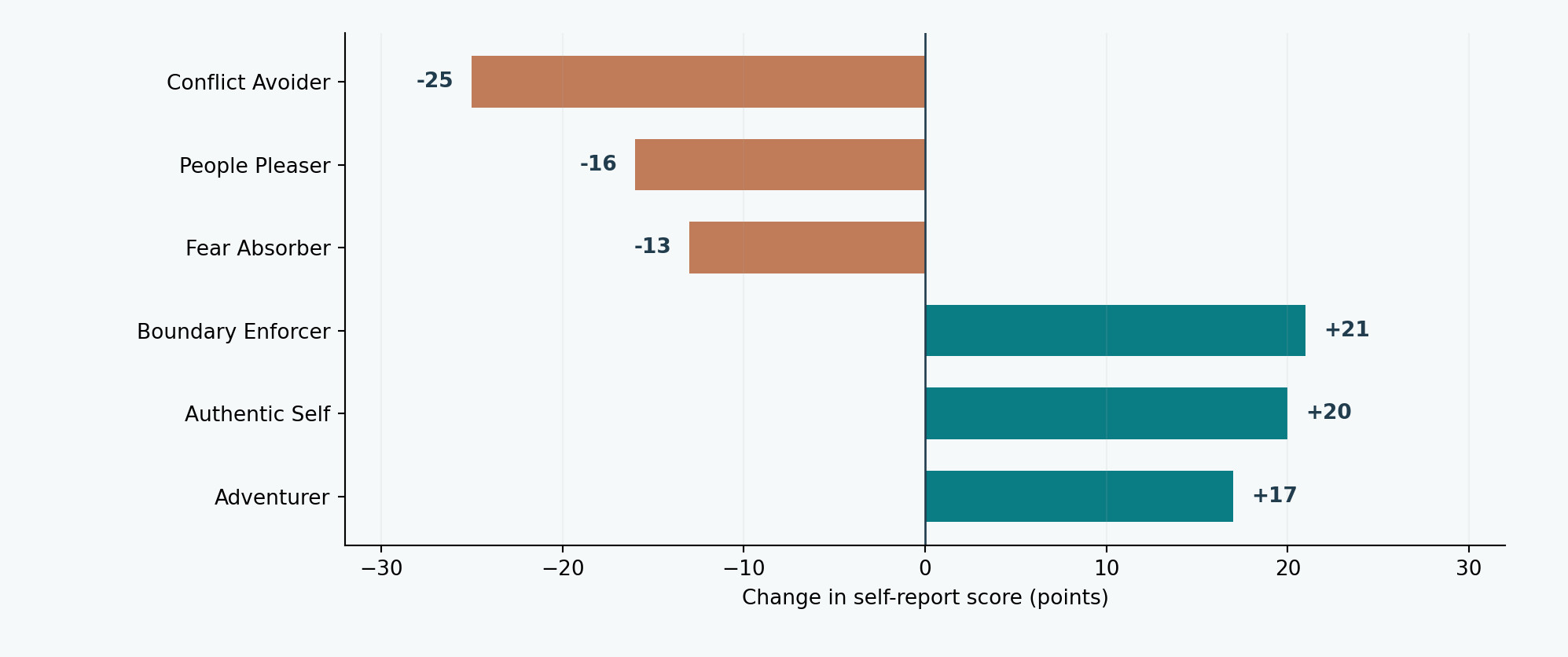
Six reported changes from earlier to later Wilder Method self-reports. Negative values indicate a lower later score; positive values indicate a higher later score. These are change scores only: absolute before/after values were not verified. They do not establish clinical improvement or deterioration.
The most useful question was not, How can I get every number higher? It was, What do these responses reveal about how I actually function—and what do I need to do differently? Lower scores can reflect greater self-awareness, a real change, different interpretations of questions, or ordinary measurement variability. The numbers are conversation starters, not verdicts.
The strongest trait does not erase the weakest link
My October 8, 2026 profile illustrated another tension. The parts of me drawn to possibility, connection, and leadership scored relatively high. The part associated with routine conscientious self-management scored lower. The scores did not say I was incapable of perseverance. They suggested that my enthusiasm for meaningful work and my capacity to organize everyday commitments were not identical.
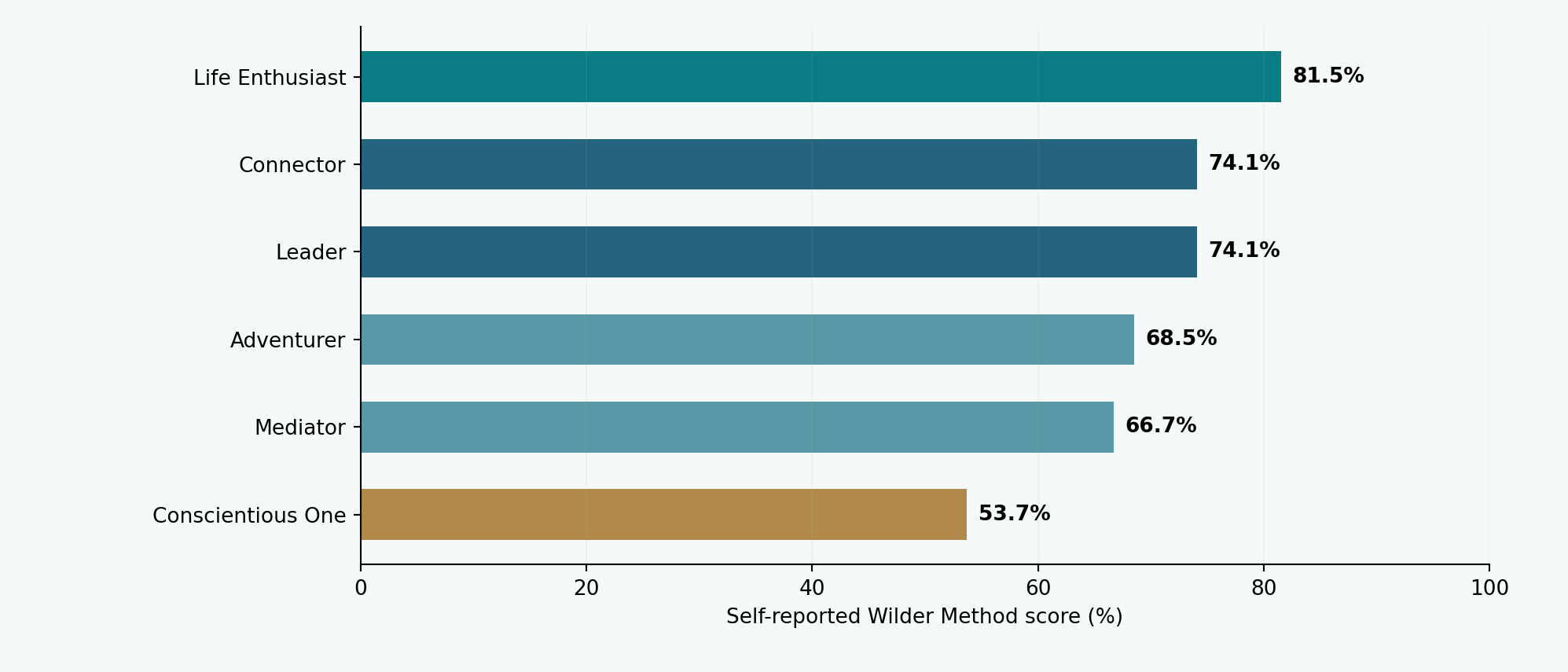
Six Sides scores from the October 8 Wilder Method profile. Percentages are proprietary self-report scores, not clinical percentiles, probabilities, or diagnostic indicators.
That distinction matters because it is easy to organize your life around your strongest instincts. You feel capable because you can dream, connect, and act decisively. Then your calendar, your unfinished tasks, or your neglected boundaries reveal the capacities you did not build into the plan.
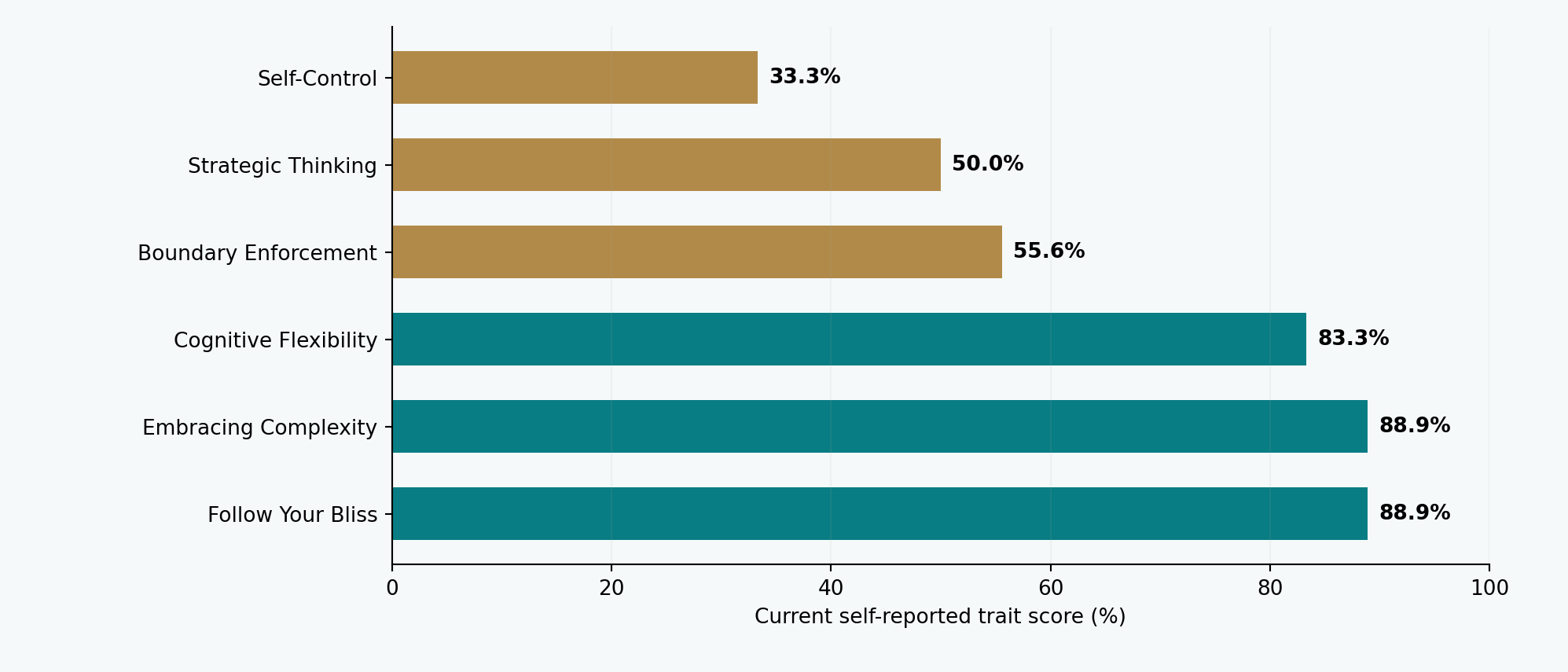
Selected trait-cluster scores from the same October 8 assessment. The contrast is descriptive, not diagnostic; it highlights areas for reflection and practical support.
A low self-control score does not mean a person has no self-control. Nor does a high creativity score establish extraordinary talent. These are exploratory, self-reported constructs. But they can help a person notice a practical problem: your strongest abilities may show you what is possible, while your weakest capacities may determine how you need to structure the journey.
The limits of motivation
There is a seductive certainty in believing that the next insight will finally solve everything. I recognize that certainty in myself. At times my vision became grandiose. I could invest enormous emotional meaning in a future version of my life and become almost superstitious about the idea that conviction itself would make it real.
That does not mean every large ambition is delusional, nor does it justify applying a personality diagnosis to ordinary ambition. It means I have had to reckon with moments when my confidence outpaced evidence, when my self-image resisted correction, and when the need to matter made it difficult to recognize limits.
“Sometimes the way forward begins by coming down from the person you imagined you had to become.”
A motivational breakthrough can be emotionally powerful. It can help us begin. But it cannot substitute for realistic workload, sleep, treatment when needed, a workable calendar, help from other people, and the daily structure required to sustain change. The Monday after the mountaintop still needs a plan.
Coming down to earth
I used to think that accepting a limitation meant surrendering to it. Now I am learning to distinguish acceptance from resignation. Acceptance means describing reality accurately enough to respond to it. It does not mean that a limitation is permanent, that treatment cannot help, or that growth is over.
For me, it means slowing down. Choosing fewer priorities. Using external reminders and routines. Building boundaries around my time. Saying no to opportunities that are exciting but unsustainable. Seeking structure rather than assuming that a surge of determination will somehow make structure unnecessary.
Imagine someone with six active projects, forty unfinished tasks, and an endless supply of ideas. Their old plan is to become more disciplined and work longer. Their new plan is to identify two real priorities, break them into small next actions, reserve time for administrative work, use reminders, and deliberately postpone the rest. They may also seek assessment or evidence-based treatment for ADHD or anxiety if symptoms warrant it.
The breakthrough is not that they have become limitless. It is that their plan finally reflects their actual capacity.
The cave within
At Wilder Method, I have long used the image of Enter the Cave to describe confronting what we fear or avoid. I once thought of that cave primarily as an external challenge: the difficult conversation, the courageous decision, the risk worth taking.
I have come to see that one of the hardest caves is internal. It is the willingness to say, I cannot keep doing everything the way I have been doing it. I need help. I need boundaries. I need to stop confusing being capable with being limitless.
Sometimes we must reach the end of our familiar strategies before we become willing to see ourselves more accurately. That moment can feel like failure. But it may be the first moment in which genuine change becomes possible.
A different kind of purpose
I want Wilder Method to help people who have spent years believing they are lazy, undisciplined, weak, or fundamentally flawed—when they may never have received a clear explanation of how their minds work. That means taking ADHD, anxiety, relationships, and life transitions seriously as clinical concerns, while also helping people identify strengths and build practical systems for living.
It means using evidence-based psychotherapy and appropriate assessment, alongside reflective visual and experiential tools that help people make their patterns concrete. The proprietary tools are not diagnostic instruments, and cold-water immersion is not an established ADHD treatment. The goal is not to sell people another moment of inspiration. It is to help them translate understanding into sustainable action.
I spent much of my life believing that my purpose would be found by discovering how much more I could become. Now I wonder whether the deeper journey begins with accepting who I actually am—not the idealized version, but the person whose strengths and limitations are both real.
“Find your genius. Know your limits. Finish your journey.”
Perhaps the bravest thing we can do is not prove that we have no limits. Perhaps it is to become honest enough to recognize them, humble enough to learn from them, and courageous enough to build a life that works.
ABOUT THE AUTHOR
Bill Wilder, LCMHC
Bill Wilder is a specialized mental health therapist, ADHD and life transition specialist, and founder of Wilder Method. With more than 25 years of experience in mental health, he helps adolescents and adults navigate ADHD, anxiety, life transitions, and relationship difficulties.
Drawing on his clinical background and personal experience with ADHD, Bill combines evidence-based psychotherapy with creative visual and experiential tools and exploratory Wilder Method assessments. His work focuses on helping people recognize patterns of overthinking, self-doubt, people-pleasing, and avoidance, understand both their strengths and limitations, and build practical strategies for lasting change.
Bill operates a specialized mental health therapy practice in downtown Cornelius, North Carolina, serving individuals, couples, and families in the Lake Norman area. He is also exploring the integration of guided cold-water immersion as an experiential component of his broader therapeutic enterprise.
EDITORIAL & ASSESSMENT NOTES
This is a first-person reflective essay, not a peer-reviewed study. The illustrated Wilder Method figures represent one individual’s proprietary self-report results and selected reported changes, not a research sample, validated clinical norms, or objective evidence of improvement. The October 8, 2026 screening report also documented ASRS-v1.1 6/6 positive items, GAD-7 11/21, PHQ-2 0/6, and WSAS 6/40; screening alone does not establish diagnosis or causation. For evidence-based background on ADHD assessment and treatment, consult the National Institute of Mental Health and the CDC.

Conversation
Loading comments…